+91-8851368009

A Holistic Education is about helping children improve in every aspect and not just in the classroom, but also in emotions, as well as values, health, and even creativity. In India in 2026, many schools are taking a step beyond the textbook and marking. They teach life skills such as problem-solving, teamwork, and also how to remain mentally healthy. This kind of instruction helps children become confident, compassionate, and ready for life. Educrest International School follows this approach to help students succeed who are doing well on exams and also achieving success in their careers.
Author: Sapna, a Content Writer
What Is Holistic Education?
Holistic education means (in simple terms)
A holistic education is the process of teaching the entire child, not just the brain.
Instead of focusing solely on exams and books The holistic education system supports:
- Learning in the academic environment
- Emotional understanding
- Physical health
- Social skills
- Moral values
- Confidence and imagination
What Is Holistic Learning?
Holistic learning is the method pupils learn when all aspects of their growth are interconnected.
For instance:
- Science lessons include group work and experiments.
- A language class promotes the use of language and self-expression
- Sporting activities teach discipline as well as leadership and self-confidence
- Music and art can help with concentration and creativity
This kind of learning aids students to comprehend concepts in depth instead of merely memorizing them.
Why Holistic Education Is Important in India 2026
India is changing rapidly. Technologies, jobs, and lifestyles are constantly evolving. Students require more than knowledge of the subject to succeed. Here’s why a holistic approach to learning is becoming more important:
1. Tests alone don’t define success.
Achieving high marks does not necessarily indicate confidence or problem-solving abilities. A holistic education helps students prepare for actual issues and not just for exams.
2. Mental Health Issues
Stress, anxiety, and pressure are common among today’s students. Education that is holistic supports the emotional well-being of children by helping students feel comfortable, secure, and motivated.
3. NEP 2020 Supports Holistic Growth
In India, the National Education Policy (NEP) 2020 strongly supports:
- Learning through skill-based instruction
- Critical thinking and creativity
- Arts and sports
- Values and life skills
It makes the holistic model of education an ideal model that is future-driven for Indian schools.
Holistic Development Meaning Explained Simply
Holistic development meaning: The total development of a child’s life in every aspect of their life.
It covers five areas:
- Development of the mind Thinking and learning, understanding
- The development of emotion Controlling feelings and stress
- Physical development – health, fitness, coordination
- Social development – teamwork, communication, empathy
- Moral development – values, respect, responsibility
A child who grows in all of these areas develops into a well-rounded and confident person.
Holistic Development of Students in Modern Schools
The holistic development of students cannot be achieved in a single day. It requires a conducive environment in terms of teaching techniques, as well as the school’s environment.
In forward-thinking schools such as Educrest International School students are encouraged to:
- Ask questions
- Discuss your thoughts
- Participate in activities
- Learn from your mistakes
- Be respectful of others
The result is students who’re interested and confident. They are also able.
What Is a Holistic Approach to Education?
A holistic approach to education concentrates on the way pupils learn and not only the things they acquire.
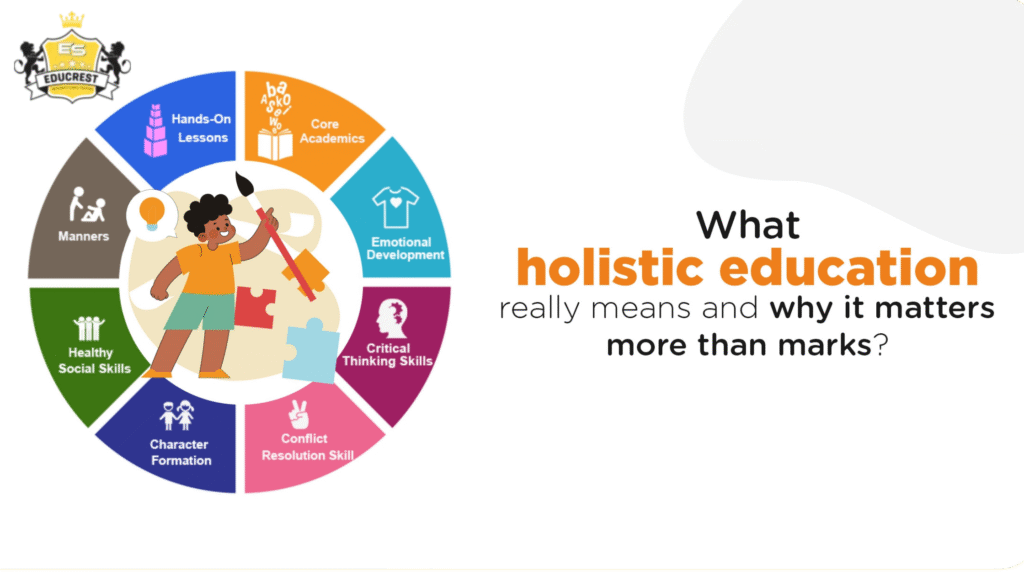
This includes:
- Learning through activities
- Education based on projects
- Discussions in groups and collaboration
- Yoga, sports and physical education
- Music, arts and creative thinking
- Education and life skills are essential.
Teachers are mentors and guides and not only lecturers.
How Holistic Education Works in the Classroom
Holistic education is both practical and accommodating to students. This is how it works in classrooms with real students:
Learning Through Activities
Experiments, activities, projects, role-play as well as discussions, make the lessons enjoyable and memorable.
Concentrate on understanding, not Memorizing
Instead of memorizing the answers, students are encouraged to learn the reason they are there and what things are done.
Equally important are sports and the Arts
Dance, physical education, music, art, and physical education are in the same way as academics.
Social and Emotional Learning
Students develop collaboration, empathy as well as leadership skills, communication, and empathy through everyday interactions.
Benefits of Holistic Education for Students
The benefits of a holistic approach to education go beyond the classroom.
1. Enhances confidence
Students are comfortable expressing their ideas and their opinions.
2. Enhances Academic Performance
If students are enthusiastic about studying, their academic outcomes naturally improve.
3. Develops Life Skills
Skills like communication, problem solving, and making decisions are honed at an early age.
4. Supports Mental Well-being
A healthy routine can reduce stress and improve happiness.
5. Preparing Students for the Future
Holistic learners can easily adapt to the changing demands of career paths as well as technology and social conditions.
Why Parents Are Choosing Holistic Education
Parents today are looking for more than only high marks for their children.
They would like their child to:
- Be confident and trusting
- Handle pressure positively
- Respect other people
- Be healthy and happy
- Be prepared for the future challenges
Holistic education is able to meet all of the expectations of parents and is the most popular choice for modern families.
Role of Teachers in Holistic Education
Teachers play a crucial role in holistic learning.
They:
- Encourage curiosity
- Help with emotional growth
- Recognize the strengths of every child.
- Create an environment of learning that is secure
In Educrest International School, teachers are taught to help every child’s particular learning experience.
Holistic Education vs Traditional Education
| Traditional Education | Holistic Education |
| Make sure you are focusing on your tests | Concentrate on growth in general |
| Memorization | Understanding & application |
| Activities are limited | Activity-based academics and balanced academics |
| Teacher-centered | Student-centered |
| Marks-driven | Life-skills driven |
This is the reason why holistic education is creating how we think about the future of education throughout India.
How Educrest International School Supports Holistic Learning
The school, Educrest International School, the holistic approach to education is a part of the daily learning process.
The school’s focus is on:
- A solid academic foundation
- Arts, sports and creative thinking
- Education based on value
- Social and emotional development
- A safe and secure environment
The students are encouraged to play, explore, and express themselves in a way that is completely free.
Why Holistic Education Is the Future of India
Beyond 2026, India needs students who are:
- Creative thinkers
- Strong and emotional
- Socially responsible
- Physically physically active
- Morally solid
The holistic approach to education helps students prepare for life beyond tests. This is why it’s not a trend, but the future.
Testimonial
Parent Perspective
“Educrest International School” is a school that focuses on an integrated education in the real sense. My child has benefited not just in academics but as well in confidence, creativity, and communication. The focus on the whole-person approach to learning has made school enjoyable and easy. ” -Parent of a student in Grade 4.
Student Voice
“I enjoy studying in Educrest since we do not read books. We engage in projects, activities, as well as sports and group work. It helps me comprehend better and also feel more at ease when speaking. ” Student in Grade 6.
Teacher Perspective
“Holistic education helps us understand the strengths of each child. In Educrest International School, we help students develop in their academics, emotionally, and socially, helping them prepare for the real world. ” — Senior Educator
Parents on Future Readiness
“The comprehensive approach towards education offered at Educrest has made my child more responsible and independent. I’m seeing positive shifts in teamwork, problem-solving abilities, and overall development. ” -Parents of a Middle School student
Confidence Well-Being
“Since having joined Educrest International School, my child is happier and more content. The school really supports the whole child’s development by balancing academics, values, as well as extracurricular activities. ” -Parents
Final Thoughts
Holistic education transforms the way that children study in India. It is focused on learning through the overall development of children as they grow into confident, competent, and compassionate individuals.
As education continues to change, schools that follow a holistic approach to education will set the standard.
In Educrest International School the holistic approach to learning makes sure that every child is not only able to achieve academic achievement, but to live a fulfilling and rewarding life.
FAQ’s
Q1. What is holistic education?
Ans: Holistic education is a method of learning which focuses on the child’s development throughout the entire process, which includes emotional, academic and physical health, as well as creativity and values, as well as the life-skills, and not only exams.
Q2. What is the meaning of holistic education in simple words?
Ans: Holistic education involves teaching the whole child – mind as well as body and soul. Students acquire the knowledge, confidence, values and abilities that are needed to be successful in real life.
Q3. Why is holistic education important for students?
Ans: Education that is holistic helps students become emotionally strong and skilled learners by balancing academics as well as values, creativity and overall mental health.
Q4. What is a holistic approach to education?
Ans: An approach to education that is holistic is based on the concept of learning through activities such as real-life situations, collaboration, teamwork, and personal development, not just books and memorizing.
Q5. What does holistic development of students mean?
Ans: A holistic education for students means improving their academic performance, emotionally, physically, socially and morally. Children develop into responsible, balanced, and future-ready.
Q6. How does holistic learning help children in the future?
Ans: Holistic learning helps develop problem-solving abilities and confidence, as well as adaptability and emotional intelligence. It helps students excel in their studies, career, work, and in everyday life.